Scientists reveal how to make the perfect boiled egg
- READ MORE: Unusual and fascinating ways people like to spice up their cups of tea
It is one of the most elementary tasks that can be performed in the kitchen.
It appears you've likely been cooking your eggs incorrectly.
Researchers have discovered the optimal method for cooking eggs to achieve a perfectly cooked yolk and a firm, non-watery egg white.
The only downside, for those accustomed to a quick six-minute soft-boiled egg, is that the new method requires more than half an hour.
Experimented with 300 eggs to determine the optimal method for cooking one in its shell, with regards to texture, flavor, and nutritional value.
They were comparing a hard-boiled egg, a soft-boiled egg, the "sous vide" version popular in upscale restaurants, and a completely new technique.
This method, which alternates an egg eight times between a pot of boiling water and a bowl of cold water, is considered the ultimate solution by the experts.
It resolves the issue of a perfectly cooked yolk and undercooked egg white, which occurs when an egg is boiled in its shell.
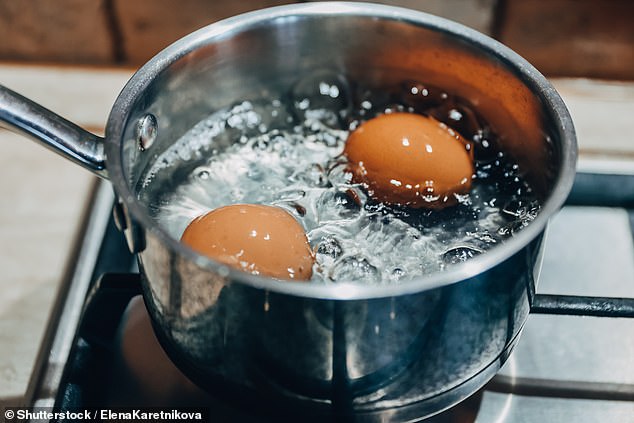
Scientists successfully heated the egg white to an optimal temperature of 85°C, and the yolk to almost the ideal temperature of 65°C.
The key is to frequently remove the egg from the boiling water and submerge it in cold water, in order to prevent the yolk from becoming hard-boiled and solid, while allowing the egg white to be heated sufficiently to achieve the desired level of firmness.
Professor Ernesto Di Maio, a senior author from the University of Naples Federico II, whose research typically focuses on plastics, developed the "periodic cooking" method and successfully prepared all 300 eggs in his home kitchen.
He stated: "I believed that the methods we utilize in materials science could generate the ideal egg, and the outcome is truly exquisite."
'I've managed to convince 50 of my family and friends to prefer cooking eggs in this method, and they were served with lemon and pepper at our laboratory Christmas celebration.'
It may take 32 minutes to prepare this type of egg, and I know many people won't have the time, but I genuinely believe it's worth the effort for the people you care about, rather than cooking them eggs incorrectly.
This study aimed to enhance the preparation of "sous vide" eggs, which are cooked for at least an hour in a low and steady temperature, usually between 60°C and 70°C, to achieve a creamy yolk texture.
The problem with this, as Professor Di Maio points out, is that the egg white is not cooked enough and appears transparent, yet is also excessively liquid.
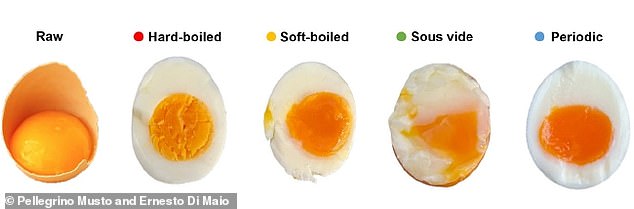
His team, led by a researcher who surprisingly turned out not to be an egg fan, employed advanced mathematical modeling to determine the optimal method for cooking eggs.
They then tested these out, using three methods involving shining light beams at eggs to see how well cooked they were and their nutritional profile.
Meanwhile, eight expert tasters were asked to evaluate the hard-boiled, soft-boiled, sous vide, and periodically cooked eggs based on characteristics including color, texture, and softness.
Among the findings, published in the journal Communications Engineering, it was discovered that an egg cooked using the periodic technique had a sweeter and saltier yolk compared to a soft-boiled egg.
The yolk was similar to that of a sous vide egg, but the egg white was less soft, moist, and translucent.
It had a consistency that was somewhere in between that of a sous vide egg and a soft-boiled egg.
Professor Di Maio said: 'This egg is easier to spread on toast, unlike a sous vide egg, which would soak into the bread.
It's still not suitable for being placed in an egg cup and served with toast as you would with a soft-boiled egg.
The new method was discovered to yield a nutritionally superior egg compared to the other three cooking techniques, although the researchers assert that further research is required to understand the cause of this outcome.
Temperatures in the periodically-cooked egg white varied between 35°C and 100°C during cooking, whereas the yolk reached a temperature of 67°C and maintained it.
Read more
Post a Comment for "Scientists reveal how to make the perfect boiled egg"