2026 Cadillac Escalade IQ: Love at First Drive
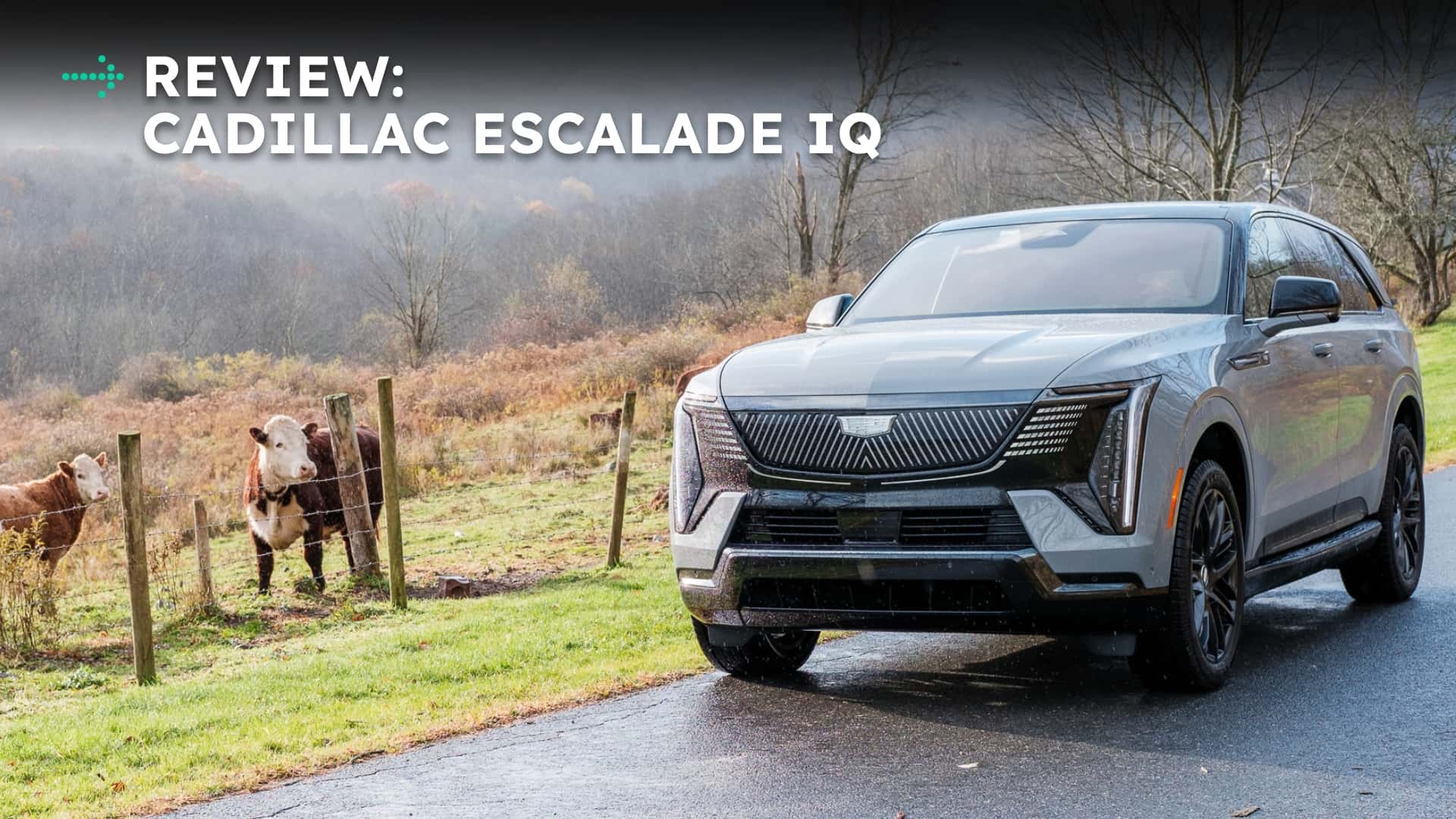
There is a growing debate about whether electric vehicles (EVs) are truly helping to save the planet or not. However, one thing is clear—America’s most iconic vehicle has taken a significant step forward with the introduction of battery power.
While many car companies are hesitant to acknowledge this shift, it has become a point of contention for a large portion of the population. The core idea behind electric vehicles is to reduce environmental impact by moving away from gasoline-powered transportation. This transition aims to cut down on pollution, which remains one of the largest contributors to environmental degradation.
The Cadillac Escalade IQ stands as a unique example in this evolving landscape. It is a massive 9,000-pound vehicle equipped with a powerful 200-kilowatt-hour battery, making it capable of long-range electric driving. However, its size and power come at a cost. When it comes to recharging, the Escalade IQ consumes a significant amount of energy, raising questions about its efficiency and environmental benefits.
The Environmental Impact Debate
Electric vehicles have been marketed as a solution to climate change, but their true impact depends on several factors. These include the source of the electricity used to charge them, the materials used in battery production, and the overall lifecycle emissions of the vehicle.
For instance, if an EV is charged using renewable energy sources like solar or wind, its environmental footprint is significantly reduced. On the other hand, if the electricity comes from fossil fuels, the benefits are less clear. This makes the broader conversation around EVs more complex than it might initially appear.
The Role of Size and Power
The Escalade IQ exemplifies the challenge of balancing size, power, and sustainability. While it offers impressive performance and range, its substantial weight and battery capacity mean that it requires a considerable amount of energy to operate. This raises concerns about whether such vehicles can be considered truly eco-friendly.
Some argue that larger vehicles, especially those designed for comfort and luxury, may not be the best candidates for electrification. However, others believe that even these vehicles can play a role in reducing overall emissions if they are powered by clean energy sources.
The Future of Electric Vehicles
As the automotive industry continues to evolve, the focus is shifting toward more sustainable practices. This includes improving battery technology, increasing the use of renewable energy, and developing more efficient charging infrastructure.
Manufacturers are also exploring ways to make EVs more accessible and practical for everyday use. This includes reducing costs, extending ranges, and improving the convenience of charging options.
Challenges Ahead
Despite the progress being made, there are still challenges that need to be addressed. One of the main issues is the availability of charging stations, particularly in rural areas. Another challenge is the environmental impact of battery production, which involves the extraction of rare minerals and the potential for waste.
Additionally, the disposal and recycling of EV batteries remain a concern. As more vehicles hit the road, finding sustainable solutions for managing end-of-life batteries will become increasingly important.
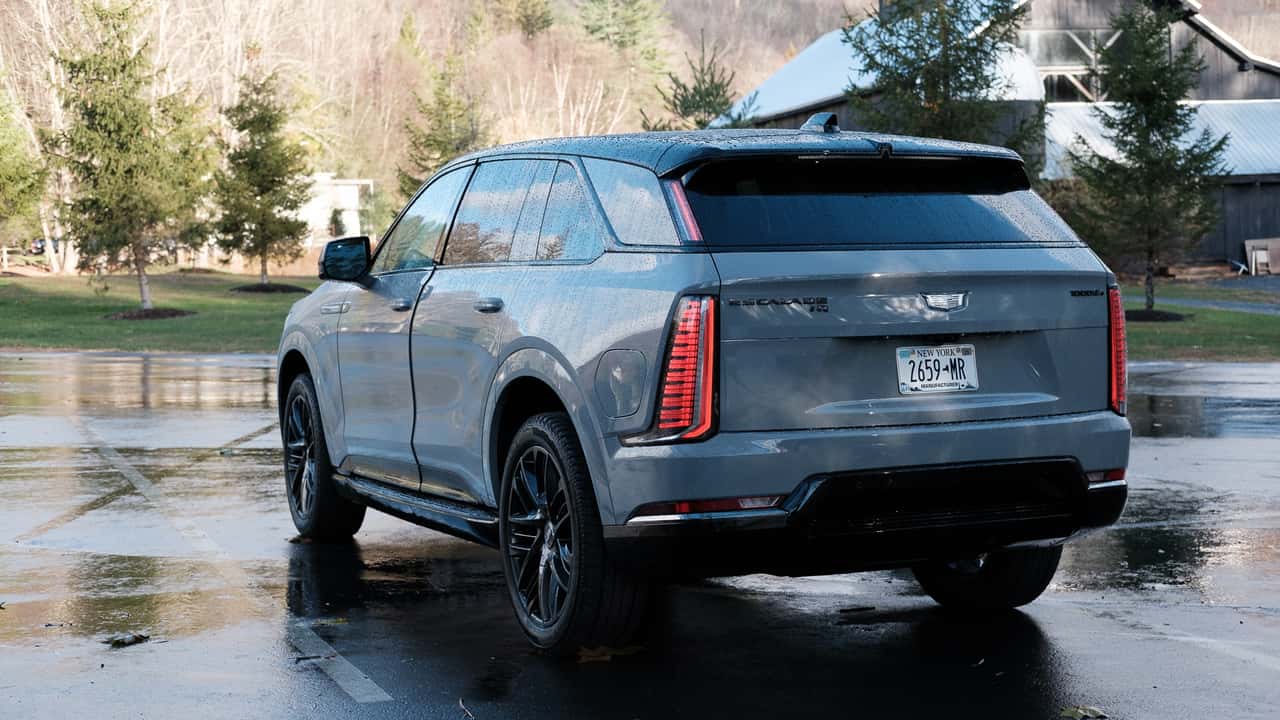
All of this—the raw materials needed for the battery, the energy it takes to make such a battery, and the lack of efficiency overall—make the Escalade IQ and its big-battery ilk deeply questionable, from an environmental perspective.
But after spending time with the Escalade IQ myself, I'd offer this counter-argument: Who cares? The electric Escalde rules.
(Full Disclosure: Cadillac loaned me an Escalade IQ for a week of testing.)
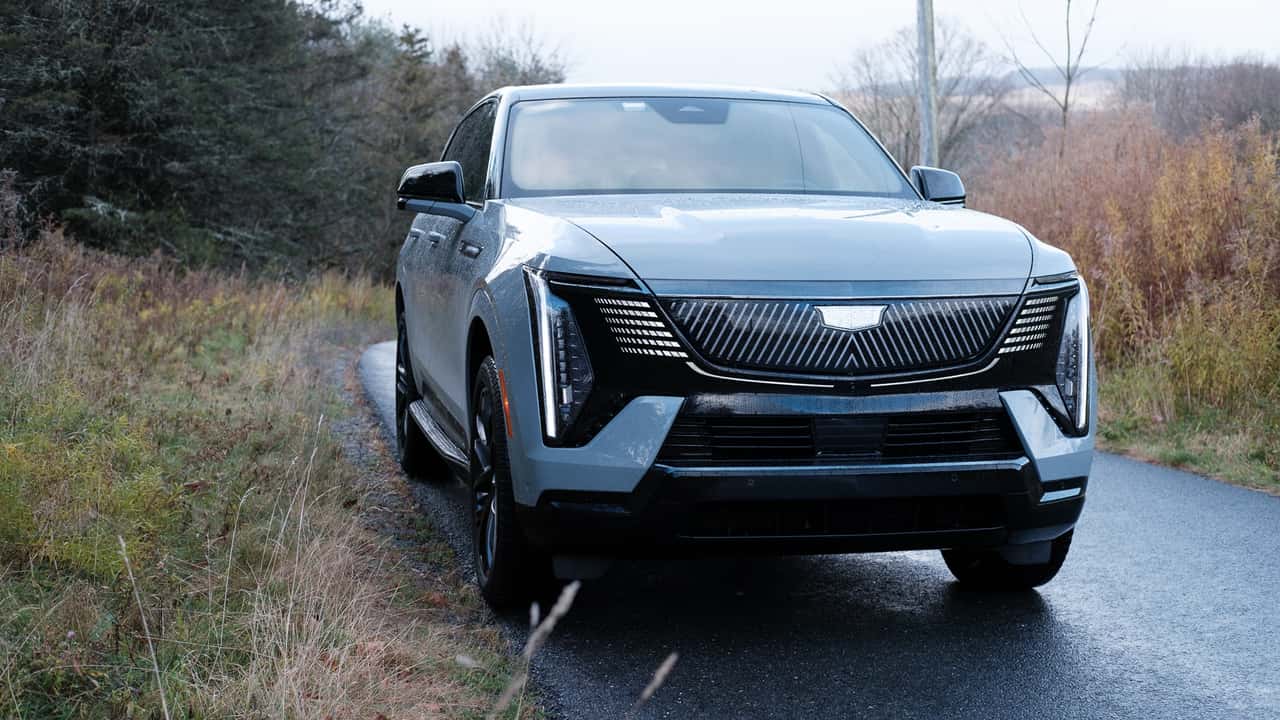
Okay, fine. That's a gross overstatement. EV efficiency is crucial for countless reasons. The huge-battery approach to trucks and SUVs probably isn't a great solution to electric transport long-term, and I have real trepidations about a vehicle this heavy being on the road at all.
That's what the logical part of my brain tells me, anyway. The less logical part—the one that has secretly always loved the Escalade—thinks this thing is better than ever when it runs on battery power.
After all, the Cadillac Escalade is America's greatest vehicle.
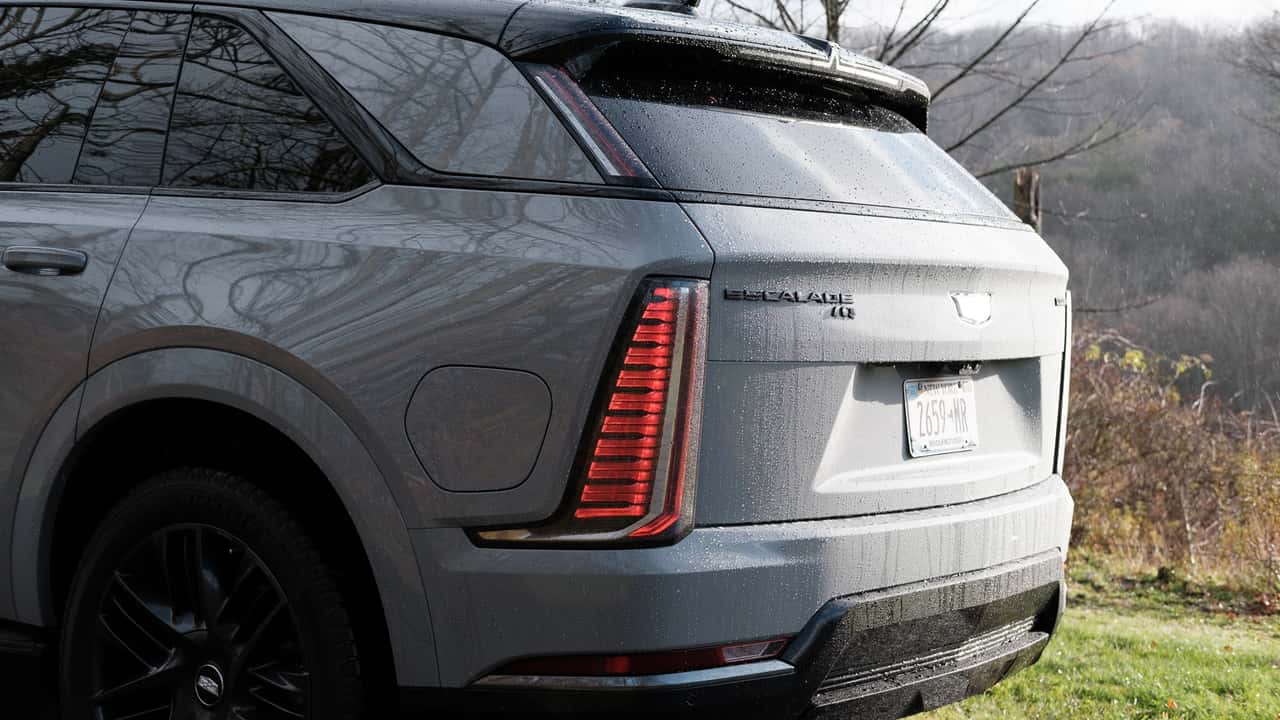
Yes, really. Did you think it'd be the Ford Mustang or something? The Tesla Model Y? Get serious.
2026 Cadillac Escalade: Driving Experience
Nothing encapsulates American values more than the Escalade does. It is titanic in size. It's instantly noticeable. It's opulent. It rules the road with tons of horsepower. It is the apex of American luxury, which is to make a vehicle as large and living-room-like as possible. It is the final-form edition of the tailfin Cadillac luxury barges of the 1960s, updated for modern tastes and sensibilities.
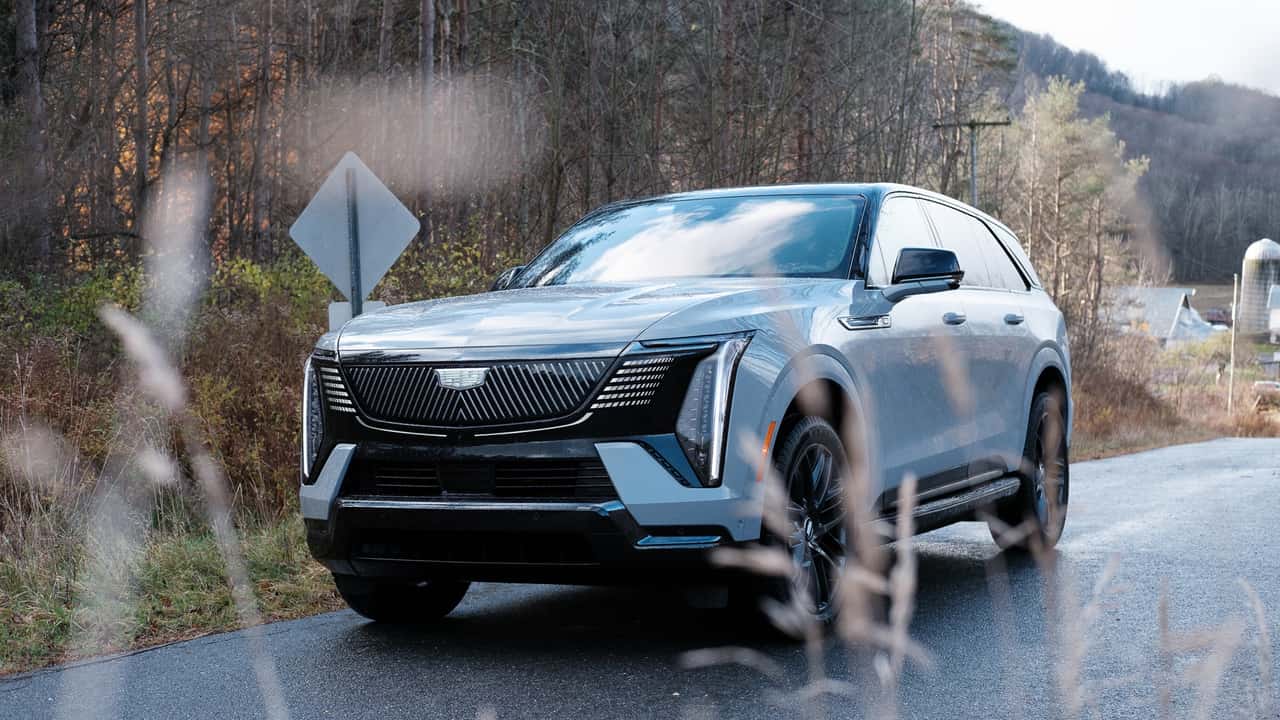
It can also tow a boat, if you need to tow a boat. Nothing is more American than that.
The purview of NBA stars, wealthy ranchers, gated-community moms and dads, and various and sundry Kardashians, the Escalade is nouveau riche incarnate—prosperity gospel on wheels. (Another uniquely American creation.) There is nothing under-the-radar about an Escalade. You buy one because you have arrived, and everyone needs to know it.
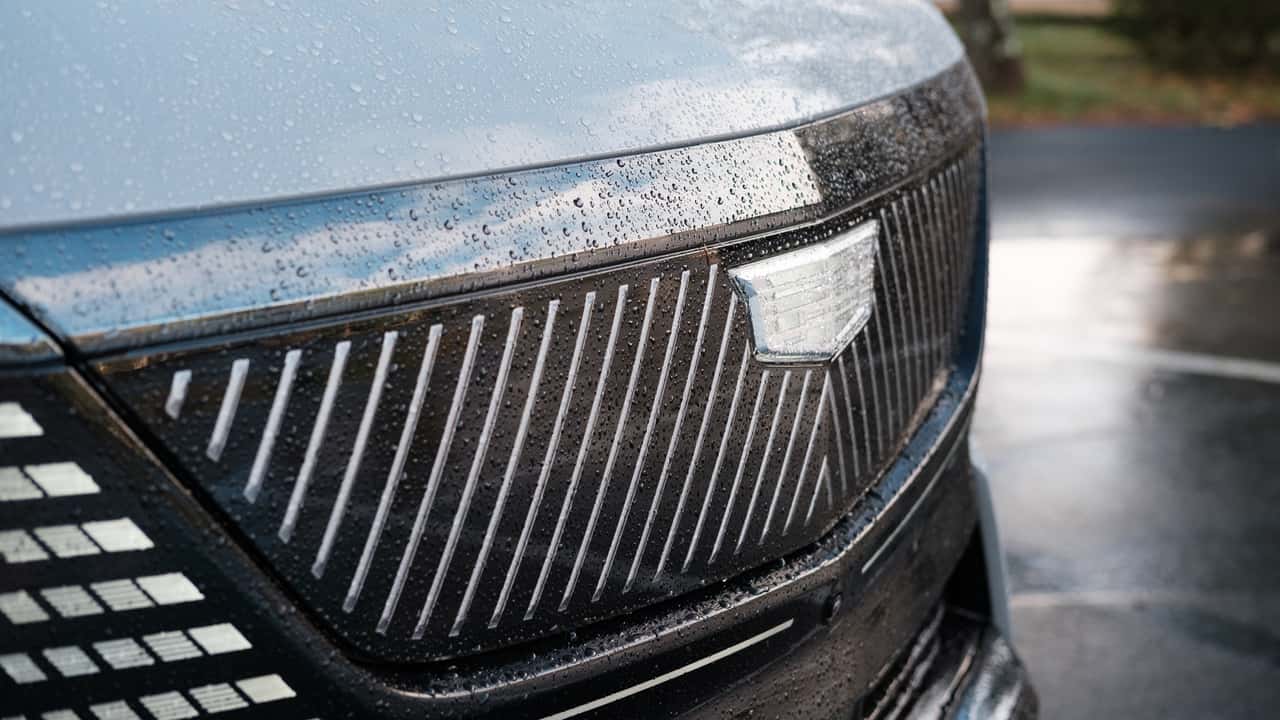
Now, we herald the arrival of the Escalade IQ. It is not merely a battery version of the V8-powered version of the Escalade, although that SUV now borrows a lot of hardware and technology from the EV. It's a wholly different vehicle built on General Motors' common EV platform and closely related to the GMC Hummer EV and Chevrolet Silverado EV.
It is worth noting that the Escalade IQ is actually bigger than the gas Escalade, then. A whole foot longer, with a bigger wheelbase, and even a little wider. If that somehow isn't big enough for you, there's the Escalade IQL now, too, which is even longer and packs yet more headroom. I can't ever say the Escalade IQ felt too small, but to each their own.
I haven't always loved GM's big EV trucks. They're all super-capable range monsters with some very unique truck features. But their price tag, sheer size and the Hummer's whole vibe have sometimes put me off. Not so with the Cadillac, however. This thing really clicked with me.
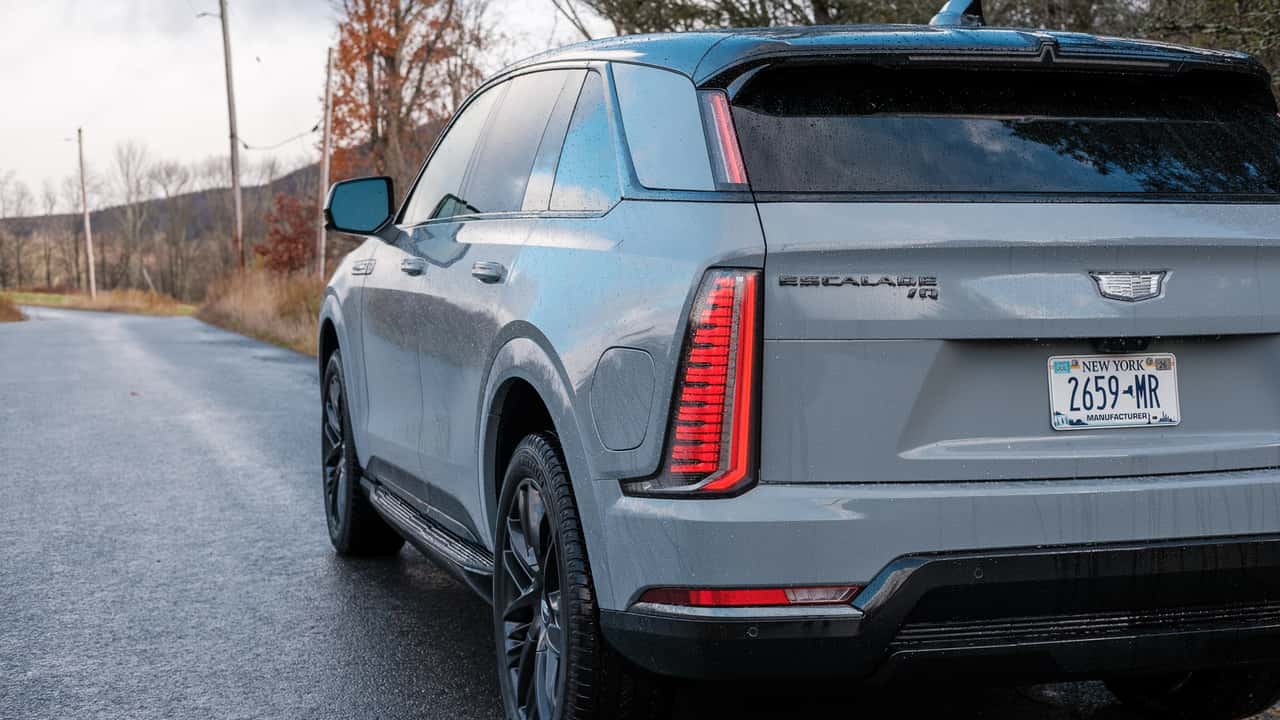
This is largely because the Escalade's character translates really well to EV duty. It's hard to replicate the thrills and feel of a small, gas-powered sports car to electric form; nobody has really pulled that off yet. But with an Escalade, you want prodigious passing power, long-distance cruising, quiet, and lots of room to carry all your gear.
Battery power helps the Escalade IQ deliver all of that, in spades. My tester, an Escalade IQ Sport (second from the bottom of a four-trim lineup) delivered 615 hp and 680 lb-ft of torque—or up to 750 hp and 785 lb-ft in the highest performance settings. That means it'll deliver 0-60 mph in approximately 4.7 seconds, making it quicker than any car I've ever owned.
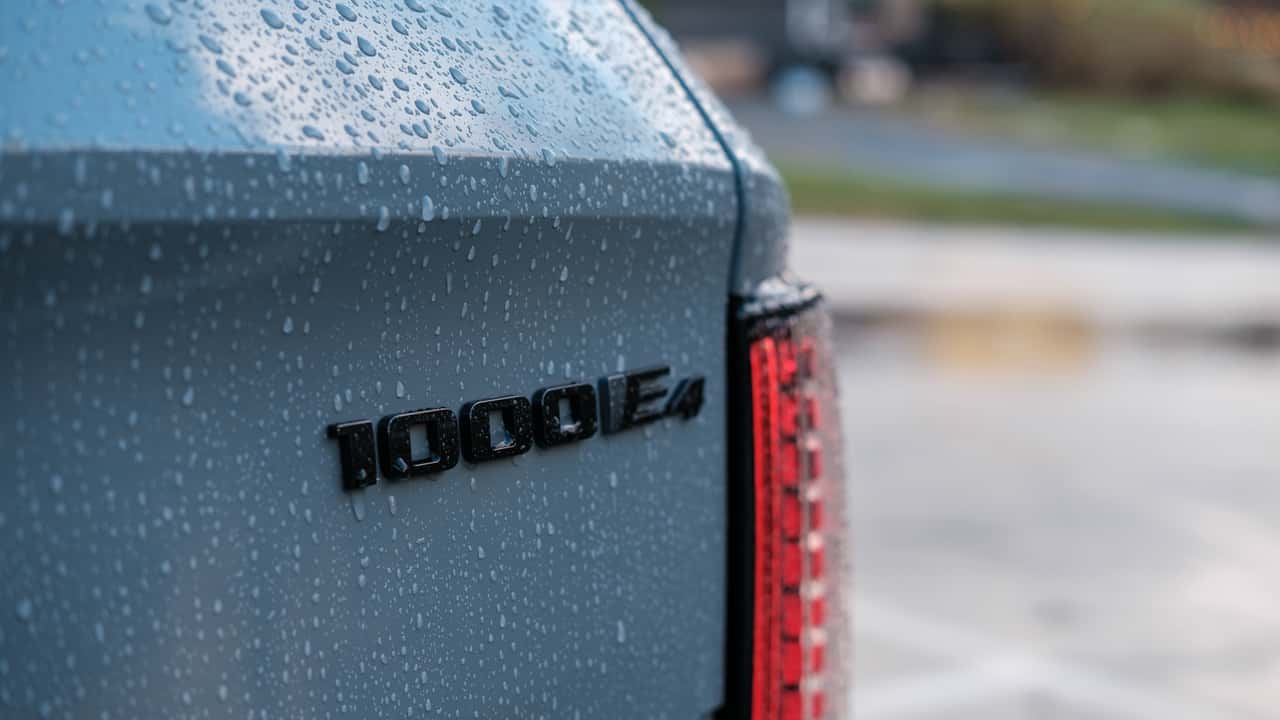
With that much power and its sheer size, nobody's going to get in your way for long on the highway. I will also say that this is the best application of GM's one-pedal driving that I have experienced yet, feeling more like a Rivian than some of the company's more jerky EVs of old.
I certainly can't say it doesn't feel large. It does. But Escalade iQ Sport comes standard with rear-wheel steering, which improves maneuverability at high and low speeds. It's also easier to park than you might expect. This is a godsend on bigger trucks and certainly welcome here.
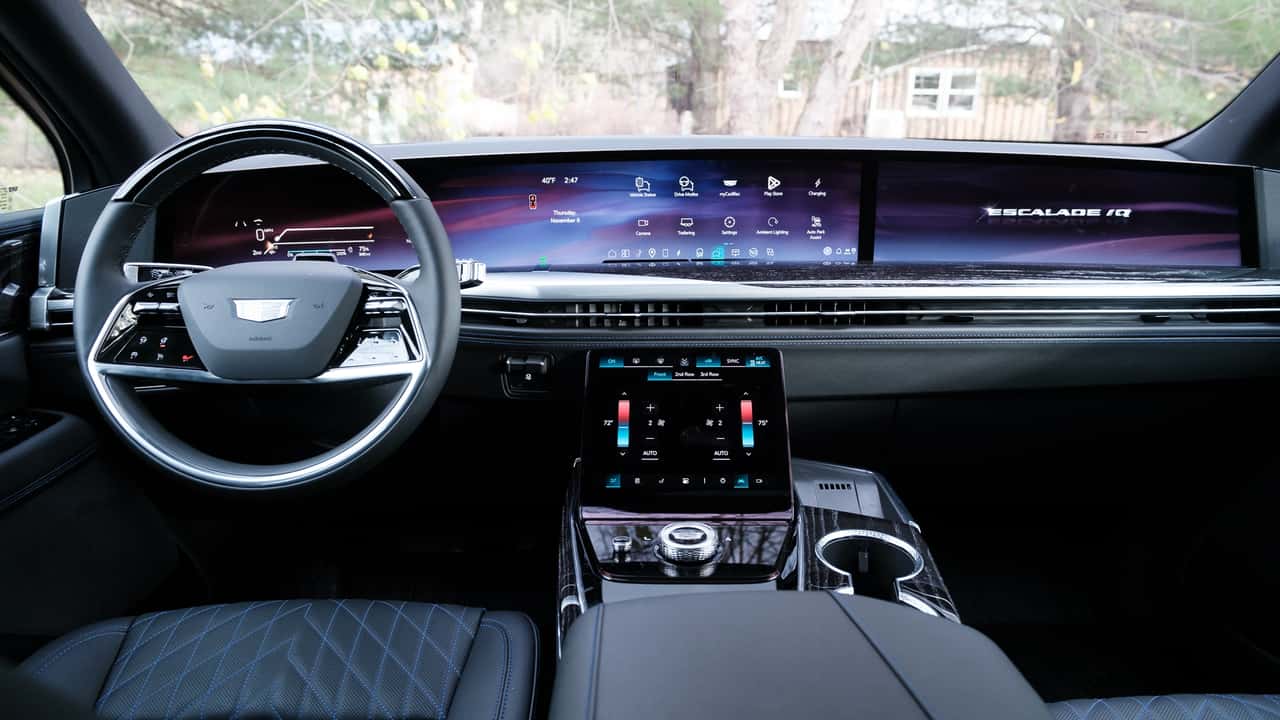
And while the 200-kWh battery is plenty controversial, I can't argue with the range it delivers: a Cadillac-estimated 465 miles of range. That ranks it among the longest-distance EVs you can buy in America, and the longest-range electric SUV.
Granted, the Escalade IQ delivers this range through brute force—just a big battery, not excellence in energy efficiency. At most, I saw around 2 miles per kWh, or almost half what my Kia EV6 can do when the weather's nice.
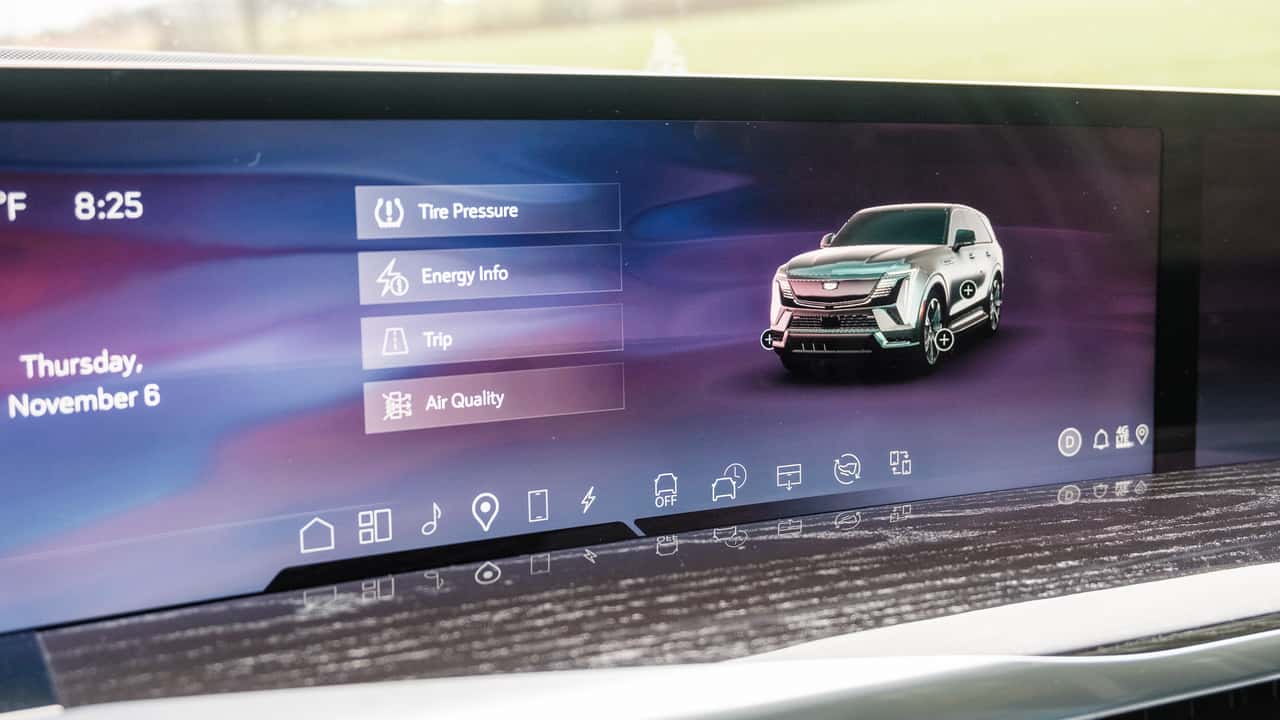
All that range is great until it's time to charge, which is a pain point on the other GM truck EVs, too. I plugged the Escalade IQ in on my home charger at 38%, and I was given an estimated charging time of 12 hours just to hit 80%. On a more reasonably sized battery, that'd take a couple of hours, max. Energy has to come from somewhere, and the big Cadillac is an energy hog.
This does mean you end up charging it less often, however. In a week of driving, including several runs from upstate New York down to New Jersey near the city, I only plugged the Escalade IQ in once.
And if you keep it around 80%, you still get a whopping 360 miles of range—I recommend you just keep it at that level unless you're road-tripping. And if you need to fast-charge, it can at least do 350 kilowatt speeds and get you 100 miles of range in just 10 minutes on a powerful enough plug.
But numbers only do the Escalade IQ so much justice. The rest has to be experienced to be believed.
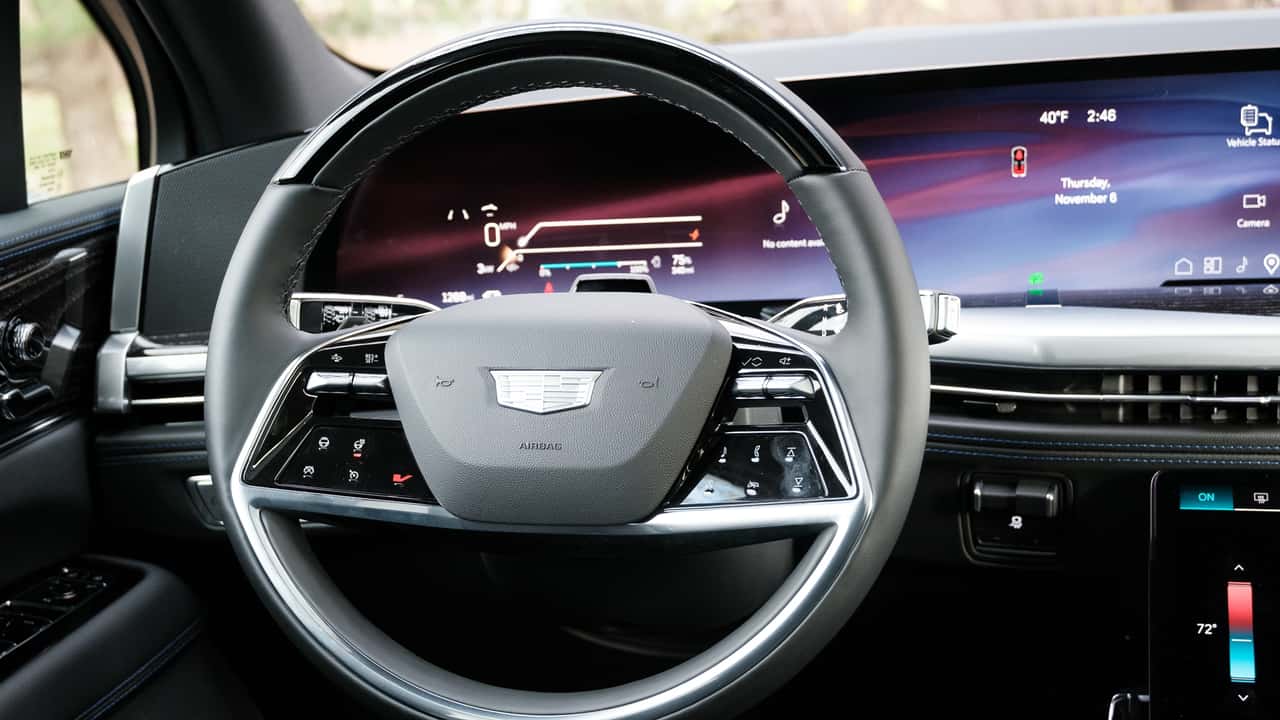
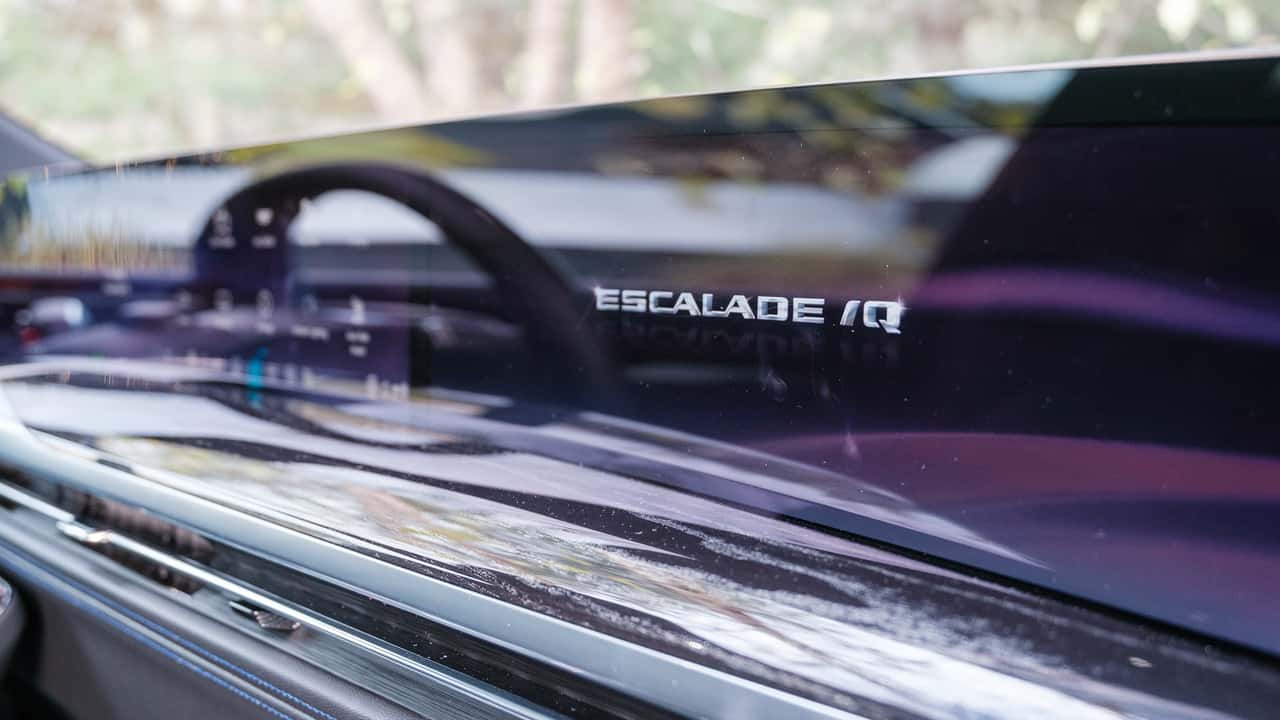
This is an unbelievably comfortable and plush vehicle, akin to riding in the luxury car of a bullet train. It's heavy on screens with so much routed through its panoramic 55-inch (!!!) LED display, but it retains enough physical buttons to make controls easy enough. And the display looks gorgeous, to boot. The overall materials are first-rate, including the plastics, and the seats are cushy as they should be.
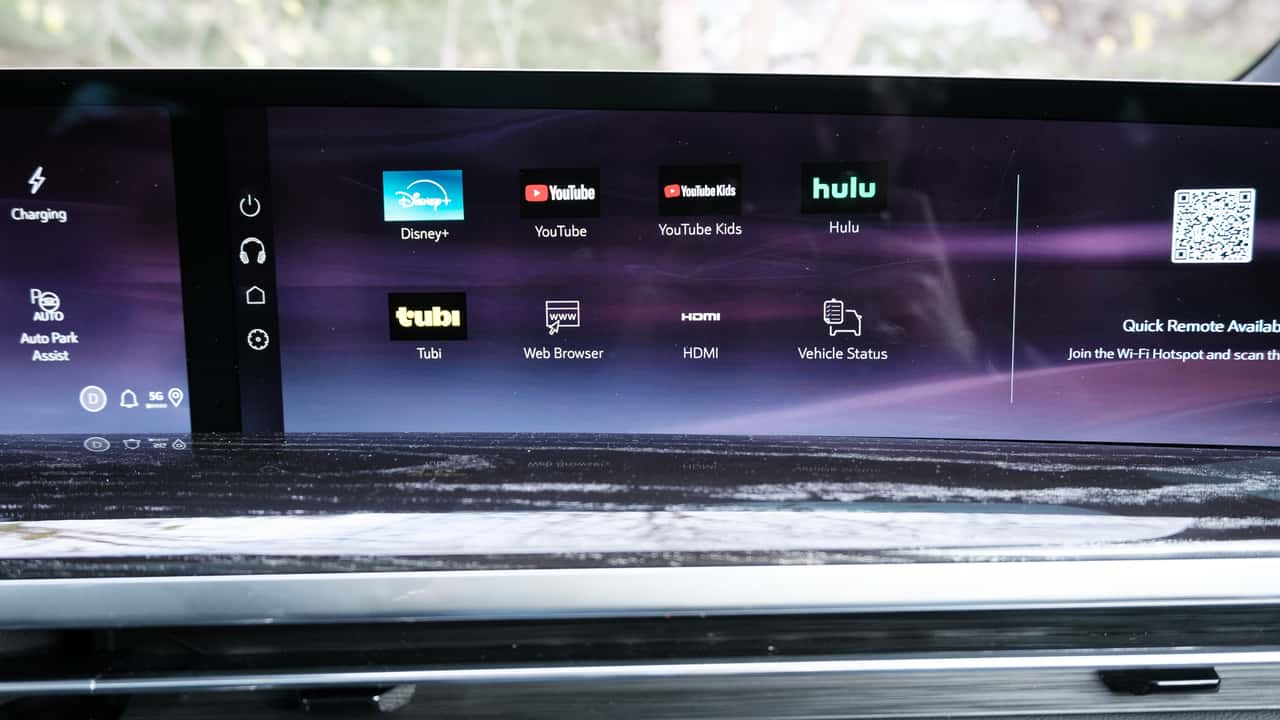
Every time I experience GM's in-car software, it gets better. While there's still no Apple CarPlay, and thus it's not as seamless and easy to do things like voice-to-text, it runs well and has a huge array of third-party apps now. It's even better in the passenger's seat or in the back.
Your occupants can fire up streaming apps like Hulu, Netflix and YouTube, although the screen is darkened so you (the driver) can't see anything. You aren't to the point where you can watch The White Lotus while the car drives itself—that's coming in 2028, when GM throws LIDAR on this bad boy.
I have consistently found the whole "passenger screen" thing a bit silly, or perhaps even just pandering to the Chinese market. But here on the Escalade IQ, it makes sense. It's not a car, so much as it is a luxury streamliner. And if you can't sit in the back, there's always hands-free highway Super Cruise, which is excellent as ever.
2026 Cadillac Escalade IQ: Pricing And Verdict
At this point, the Escalade is a kind of mini-brand within Cadillac itself, running from the base $91,000 gas version all the way up to a loaded, full-size electric $130,405 Escalade IQL. Don't forget the V versions on the gas cars, too.
A seven-seat Escalade IQ starts at $129,795; with the Onyx wheel package, a black roof, a Tesla NACS adapter and a few other options, my Sport tester came in at $137,020.
Expensive? Sure. But every Escalade I've ever been in has been north of $100,000, agnostic of what the "base" price supposedly is. And this test proves that the EV version of the Escalade is the one to get. Adding battery power here simply makes for a better, more powerful Escalade experience, and with enough range that there are basically no real tradeoffs. I don't know why you'd want the gas version of this SUV anymore. It feels irrelevant now.
I think that even GM knows this huge-battery approach to EVs can't last forever. They're too resource-intensive to make and too energy-inefficient to operate. A 9,000-pound battery Escalade isn't why we're all supposed to be here. But over time, I am confident that it, and other carmakers, will figure out battery solutions for these trucks that are better all around.
For now, the Escalade IQ solidly proves one thing: some cars are just better as EVs. And America's greatest vehicle is one of them.
Contact the author: patrick.george@insideevs.com
- Cadillac's Big Boom: 40% Of Q3 Sales Were EVs
- Cadillac Bet Big On EVs. It's Paying Off
- The Cadillac Escalade IQ Crushed Its Estimated Range In A 70-MPH Test
- 2025 Cadillac Escalade IQ: American Excess, Electrified

Post a Comment for "2026 Cadillac Escalade IQ: Love at First Drive"