Japanese Film 'Exit 8' Secures Cannes Midnight Slot
The Japanese Film “Exit 8” and Its Unique Concept
Hello, this is Shin Jeong-sun, a reporter from the Culture Department. In this edition of ‘What About That Movie,’ I will be discussing the Japanese film “Exit 8,” which opened on the 22nd. The film was invited to the Midnight Screening at this year’s Cannes Film Festival. Originally, the Midnight Screening at Cannes was a stage dominated by Korean films. However, this year, as no Korean feature films made it to Cannes, the film that ‘stole’ the Midnight Screening slot is none other than “Exit 8.”
While writing an article on the failure to enter Cannes, I checked the list of invited films and noticed works by Japanese directors. In particular, “Exit 8” piqued my interest because it was said to have taken a simple setting from a video game and turned it into a film. Is it a flimsy movie that relies solely on its setting, or a work that brings the director’s vision to life? The answer is the latter. That said, it’s not a headache-inducing film where the director only emphasizes their own world; instead, it takes a simple structure and presents it in an easy yet fresh way.
From the moment Ravel’s “Boléro” appeared in the film’s opening, I had a feeling. Ah, that’s why it’s Exit 8. Not Exit 7, not Exit 9, but Exit 8. I’ll explain why I thought that next.
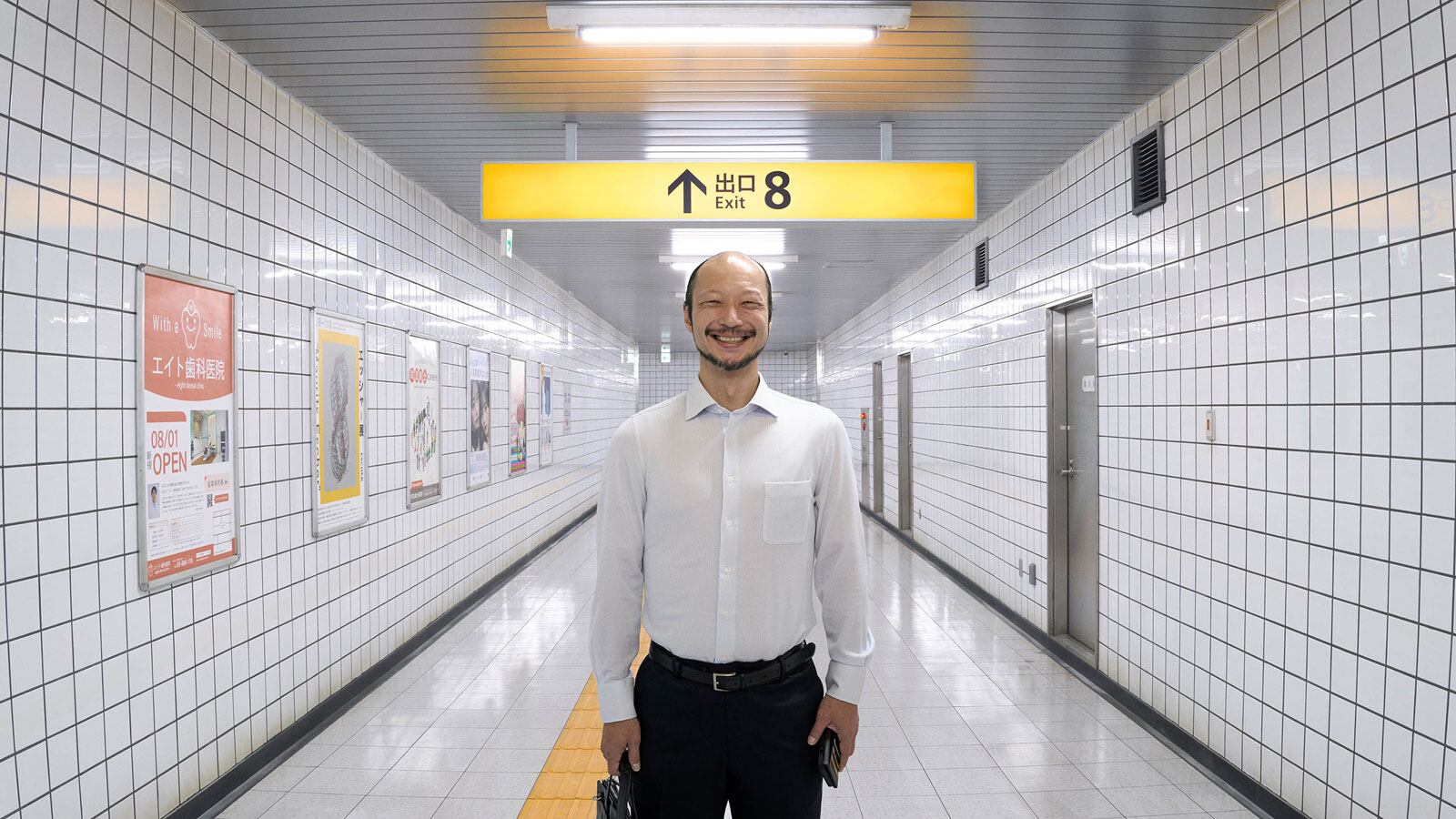
The film “Exit 8” is based on a video game that starts at Exit 0 of an underground passage and ends when you exit through Exit 8. You might think, “Can that really be a game?” But exiting isn’t easy. To advance to the next exit, you must observe your surroundings and determine if anything is amiss. If nothing is wrong, move forward; if there’s even a slight abnormality, retreat. If you advance when you should retreat, all your progress resets to Exit 0, and without exceptional observational skills, you can end up circling the same spot. Until when? Until death. Forever.
The film begins by showing the male protagonist (he has no name, referred to only as “The Wandering Man”) commuting to work on the subway. He is listening to music through wireless earphones, and that music is Ravel’s “Boléro.” As soon as the familiar snare drum rhythm of “Boléro” plays, I thought, “This is such an obvious choice.” The 17-minute piece, with its repeating rhythm, blatantly foreshadows the protagonist’s fate of being stuck in a loop. Even with earphones on, a male passenger’s shout is heard: “You’re bothering everyone! Stop it! I’m going crazy!” It was directed at a female passenger holding a crying child. The child was wailing loudly. The man glances over, then tries to resume listening to his music when his phone rings. Reluctantly answering, he hears his ex-girlfriend’s voice: “She’s pregnant.” “What? What are you going to do?” Ah, an inappropriate topic for a morning commute call. The man arrives at his stop. As he walks toward the exit, the call drops. Then, “Out of Service Area.” Now, the man is trapped. He is in an infinite loop from which he cannot escape unless he solves the problem according to the rules.
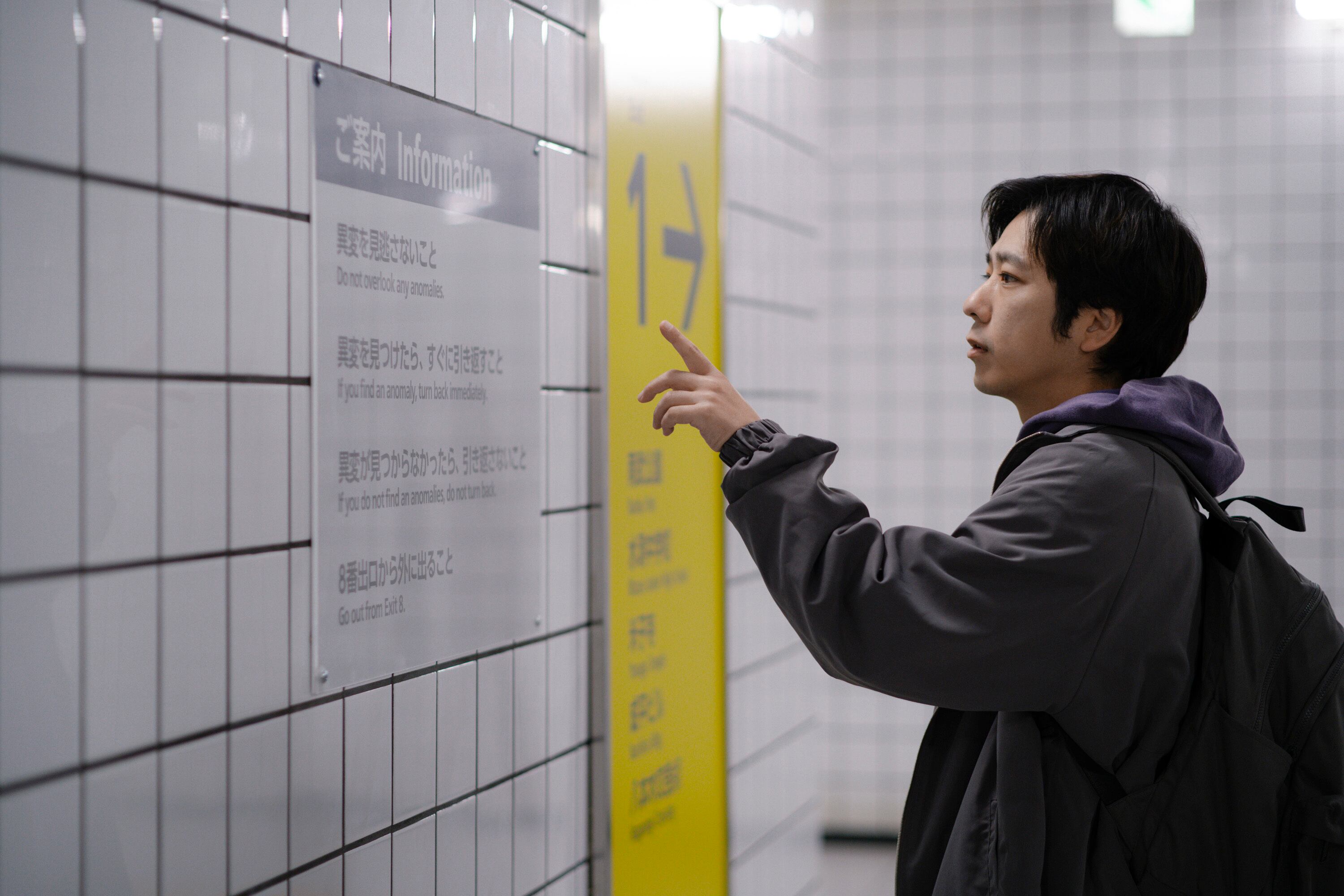
What the man must find is a sort of “spot the difference” puzzle. For example, posters are hanging on the underground passage walls, and he must check if they are displayed in order and without any changes. Are different posters attached? Have they grown in size? Has the color changed? At this point, someone might say, “Well, even if the phone isn’t connected, you can still take photos. Why not take pictures of the posters and compare them?” The protagonist naturally thinks the same. He takes photos of each poster. But if it were that easy, it wouldn’t be fun. When he tries to check the photos, they’ve all been deleted, as if someone played a prank.
Regaining his composure, the man continues forward, repeatedly checking the order and images of the hanging posters—dental promotions, Escher exhibitions, legal announcements, high-paying part-time job postings, subway etiquette campaigns, etc. At this moment, the sound of a baby crying from a subway locker. Who would put a baby in a subway locker? Then, a sudden appearance of a boy. Amidst this, his ex-girlfriend appears before him. Where on earth is this place? Is this a dream or reality?
“Exit 8” embeds the concept of repetition right in its title. The Escher work featured in the underground passage poster (which I’ll show below) is “Möbius Strip II (Ants)” from 1963. Just looking at the poster, you’ll see why the film is titled “Exit 8.” The infinite loop shape is the number 8. Therefore, you must exit through Exit 8, not any other, to escape.
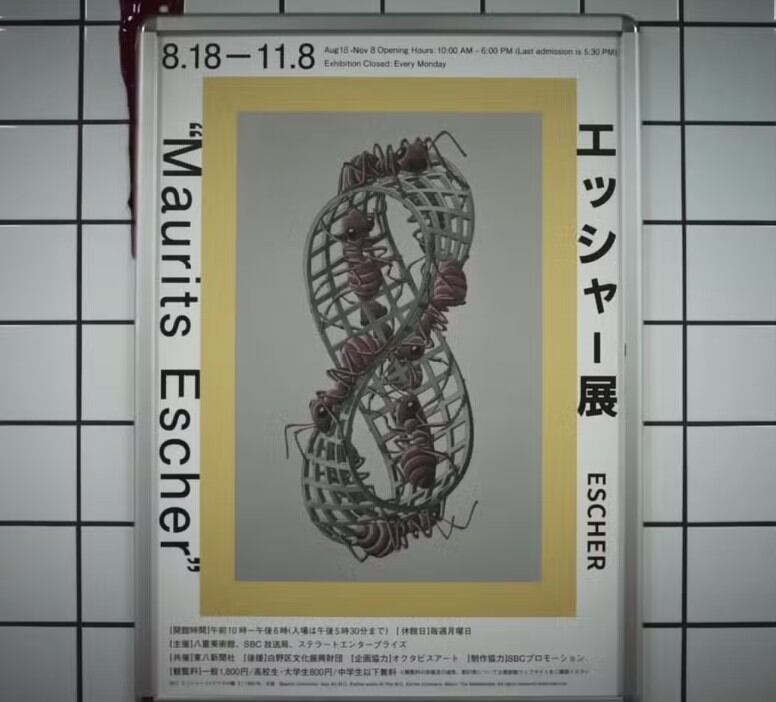
Dutch painter Escher (1898–1972) is famous for his infinite images with no discernible beginning or end. You might recall the endlessly repeating stairs in “Inception.” The maze stairs in “Squid Game” were also inspired by Escher’s art.
Perhaps the director of “Exit 8” also wanted to discuss individual moral choices and duties as members of society, but watching this film, I thought about daily life. For some, the repetitive routine can be not just tedious but terrifying. The protagonist of “Exit 8,” trapped in the underground passage, asks: Was it not myself who trapped me in this infinite loop? Did I avert my eyes when I should have faced reality, bow my head when I should have looked on?
To escape, like the protagonist of “Exit 8,” one must not miss the “abnormalities.” What seems mundane and meaningless might not be the same upon closer inspection; perhaps we’ve overlooked details. Among those overlooked details, there might be clues to make daily life slightly different or meaningful. The protagonist’s choice at the end of “Exit 8” was predictable, but it fit as neatly as the director’s clear message.
Ravel’s “Boléro” features the same snare drum rhythm from start to finish. One might think, “No need to memorize the score; it’s a breeze,” but in reality, it’s more challenging. Playing an unchanging rhythm without a single mistake requires immense concentration and passion.
The melody of “Boléro” consists of only two variations. One rhythm, two melodies. Yet, “Boléro” is a masterpiece. No matter how many times you hear it, it doesn’t grow tiresome, and it sounds different depending on the conductor.
May your daily lives, which you conduct, be different each day despite their sameness, and meaningful because of that sameness. I’ll see you in the next edition. Thank you.

Post a Comment for "Japanese Film 'Exit 8' Secures Cannes Midnight Slot"